
Email:
sales@meoen.com
EN

WHAT ARE YOU LOOKING FOR?

Design and Manufacturing Standards
1. Structural Design
Steel shelving should be structurally calculated based on actual load-bearing requirements to ensure it does not deform or tilt under maximum load.
Commonly used design standards include:
EN 15512 (European Standard): Requirements for structural design and calculation of shelving.
RMI ANSI MH16.1 (American Standard): Design specification for industrial steel shelving.
GB/T 51419-2021 (Chinese National Standard): Design specification for steel shelving.
2. Material Requirements
High-quality steel conforming to national or industry standards should be used, such as Q235 and Q345.
The steel must possess sufficient tensile strength, yield strength, and good weldability.
Surface Treatment and Corrosion Protection Requirements
Common treatment methods include powder coating, galvanizing, or painting to prevent the racks from rusting in humid or corrosive environments.
The surface should be smooth and burr-free to avoid scratching operators.
Installation and Usage Safety
1. Installation Specifications
The racks should be installed horizontally and vertically, and the foundation must be stable and reliable.
All connections (bolts, clips, etc.) must be tightened securely and must not be loose.
2. Load Capacity Marking
Each rack unit should be clearly marked with its maximum load capacity. Overloading is strictly prohibited.
3. Protective Measures
High-rise racks should be equipped with safety structures such as crash barriers and anti-tipping devices.
Aisles should be kept clear to ensure safe passage for forklifts and personnel.
Regular Inspection and Maintenance
It is recommended to conduct a comprehensive safety inspection at least annually, including bolt tightening, weld inspection, and upright deformation testing.
Any structural damage or corrosion should be repaired or replaced promptly.
Summary: The safety standards for steel racks and shelves mainly revolve around four core points: structural safety, material compliance, corrosion protection, proper installation, and regular maintenance. Strict adherence to international standards such as GB/T 51419-2021, EN 15512, or RMI ANSI MH16.1 can effectively ensure the safety and long-term stability of the racking system.
Steel shelving and racking systems are widely regarded as the best choice for storage and organization due to their space efficiency and cost-effectiveness. In warehouses, steel racks can utilize vertical space, significantly increasing storage density. For example, a steel racking system can store 30-50% more goods compared to traditional shelving. This allows businesses to maximize limited warehouse space, reducing storage costs. A typical warehouse with steel shelving can increase its capacity by up to 40% without expanding its physical footprint (Source: Grand View Research).
In terms of cost-effectiveness, steel shelving has lower long-term maintenance costs compared to alternatives like wood. For instance, the average maintenance cost of steel racking is around $5-10 per year per unit, whereas wooden shelving can incur $20-50 per year. Steel racking systems also have a longer lifespan, often lasting 10-20 years with proper maintenance. In factories and supermarkets, steel shelving's durability and high load-bearing capacity make it ideal for heavy-duty storage, reducing the frequency of replacements and improving overall operational efficiency. These figures are supported by industry reports from IBISWorld and Mordor Intelligence.
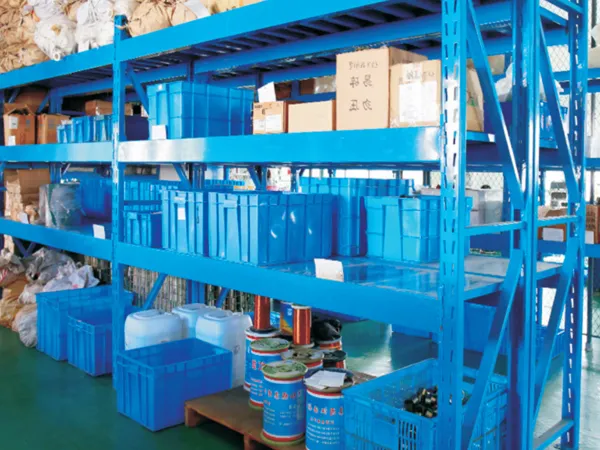

Constructed from premium steel with integrated forming technology, it delivers outstanding load-bearing performance, reliably supporting heavy goods while effectively preventing deformation or collapse to ensure storage safety.
Features excellent rust and corrosion resistance for extended service life. Requires minimal daily upkeep, significantly reducing replacement and maintenance costs of storage equipment.
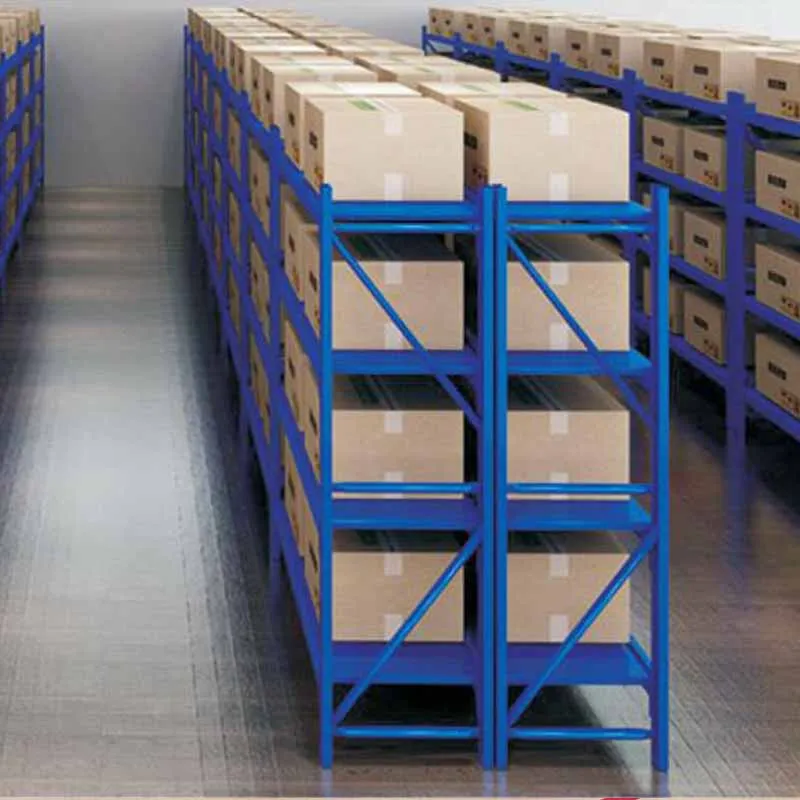
Supports multi-tier vertical design, making full use of vertical space to greatly increase warehouse storage density and support efficient storage planning.
Modular structure allows for free combination and adjustment based on goods specifications and storage needs. Simple to assemble, disassemble, and transport, making it suitable for a wide range of application scenarios.
Steel shelving and racking systems are widely used for storing goods in warehouses, workshops, e‑commerce storage facilities, logistics centers, factory storerooms, convenience store backrooms, and similar environments. They enable organized, categorized storage and efficient use of vertical space, significantly increasing storage capacity. These systems also facilitate easy access, inventory counting, and goods turnover. They are suitable for a wide range of items, including light and heavy goods, bulk materials, and oversized objects, helping various industries standardize and streamline their storage management processes.
Steel shelving and racking systems enhance warehouse management by organizing goods in a structured manner, preventing chaotic stacking, optimizing access routes, and reducing the time needed to locate and handle items—thereby improving operational efficiency. Clear load‑zone designs prevent overloading and compression, minimizing product damage and ensuring storage safety. Additionally, orderly storage enables visual inventory monitoring, helping staff quickly assess stock levels, boost inventory turnover rates, and lower management costs. Together, these features support standardized, efficient warehouse operations.
The appropriate type of steel shelving varies depending on specific storage requirements:
Beam racking is most suitable for storing large, heavy items that require frequent access.
Drive‑in/drive‑through racking is ideal for high‑density storage of uniform goods with lower access frequency.
Cantilever racking better accommodates long or bulky materials such as pipes, bars, and profiles.
Flow (gravity) racking supports FIFO (First‑In, First‑Out) inventory management for efficient stock rotation.
Mezzanine racking creates multi‑level storage areas, making effective use of vertical space in warehouses with high ceilings and increasing overall storage capacity.
To safely install steel shelving and storage racks, the following requirements must be followed. First, carefully read the product installation instructions and ensure that the installation personnel possess professional operational skills; hire a professional construction team if necessary. Before installation, check the ground's levelness to ensure a solid foundation, and secure the ground anchors as specified to enhance rack stability. During installation, strictly follow the assembly steps to ensure all connecting components are properly tightened without omission or looseness. After installation, inspect whether the rack structure is vertical and stable, and ensure that the load is evenly distributed on the shelves to avoid local overloading. Additionally, perform a simple load test to confirm compliance with safety requirements before putting it into use.
The load‑bearing capacity of steel shelving systems varies depending on the type.
Light‑duty shelving typically supports 50–200 kg per shelf, suitable for storing light, loose items.
Medium‑duty shelving can handle 200–800 kg per shelf, meeting the storage needs of most general goods.
Heavy‑duty shelving has a load capacity of 1 ton or more per shelf, designed for bulky and heavy materials.
The exact load specifications should be confirmed against the product's official documentation provided by the manufacturer. During use, goods must be stored strictly within the stated weight limits—overloading is not permitted.
Steel shelving can be customized according to spatial requirements. Manufacturers will design a personalized solution based on the user's actual space dimensions (including length, width, and height), specific needs such as the weight, size, and storage volume of goods, as well as the usage scenario and budget. The customization covers aspects including material selection, structural layout, and the number of shelves. After the design is finalized, corresponding production and installation services are provided to ensure the shelving closely matches the user’s space and functional needs.
Compared to other materials, steel offers numerous advantages for shelving manufacturing. Steel exhibits high strength and structural stability, enabling it to bear substantial weight without deformation. It boasts excellent wear and corrosion resistance, ensuring a long service life even in demanding environments such as warehouses. Steel shelving outperforms wooden alternatives in fire and moisture resistance, enhancing overall safety. Maintenance is straightforward, with easy cleaning and the option for localized repairs or replacements in case of damage. Furthermore, steel is highly recyclable, making it an environmentally friendly choice. Overall, steel shelving delivers superior cost‑effectiveness and performance compared to materials like plastic or wood.
Steel shelving and storage racks must comply with clear safety standards. In China, products are required to meet relevant national standards, such as GB/T 27924, and undergo rigorous quality inspections before leaving the factory to ensure that material thickness, structural stability, load-bearing capacity, and other indicators meet the required specifications. The maximum load capacity must be clearly labeled on the rack for user awareness of usage limits. During use, regular inspections and maintenance are necessary, including checking for loose connectors, structural deformation, surface rust, and other potential safety hazards. Timely addressing of such issues ensures that the racks remain in a safe and usable condition.
When selecting suitable steel shelving for a company, start by clarifying the specific details of the goods to be stored, including their weight, dimensions, shape, and storage volume. Next, consider the warehouse's spatial conditions, such as height, floor area, and ground load-bearing capacity. Additionally, factor in the budget and frequency of goods access—if items are frequently retrieved, prioritize shelving types designed for easy access.
Prefer compliant products from qualified and reputable manufacturers to ensure they meet safety standards. If necessary, request the manufacturer to provide inspection reports and after-sales service commitments. By integrating these considerations, you can choose the shelving system that best fits your operational needs.
For small businesses, there are many affordable steel shelving options available. Light‑duty or medium‑duty standard modular shelving is recommended, as these offer uniform specifications, cost‑effectiveness, and can be flexibly assembled and expanded according to storage needs, making them suitable for most small‑scale operations. Simple shelf‑unit designs with basic panels are also easy to install and low‑cost, ideal for storing lightweight or loose goods. Additionally, certified second‑hand shelving can be considered, provided it is carefully inspected for structural integrity, load‑bearing capacity, and overall condition to ensure compliance with safety standards. This approach helps reduce costs while meeting essential storage requirements.